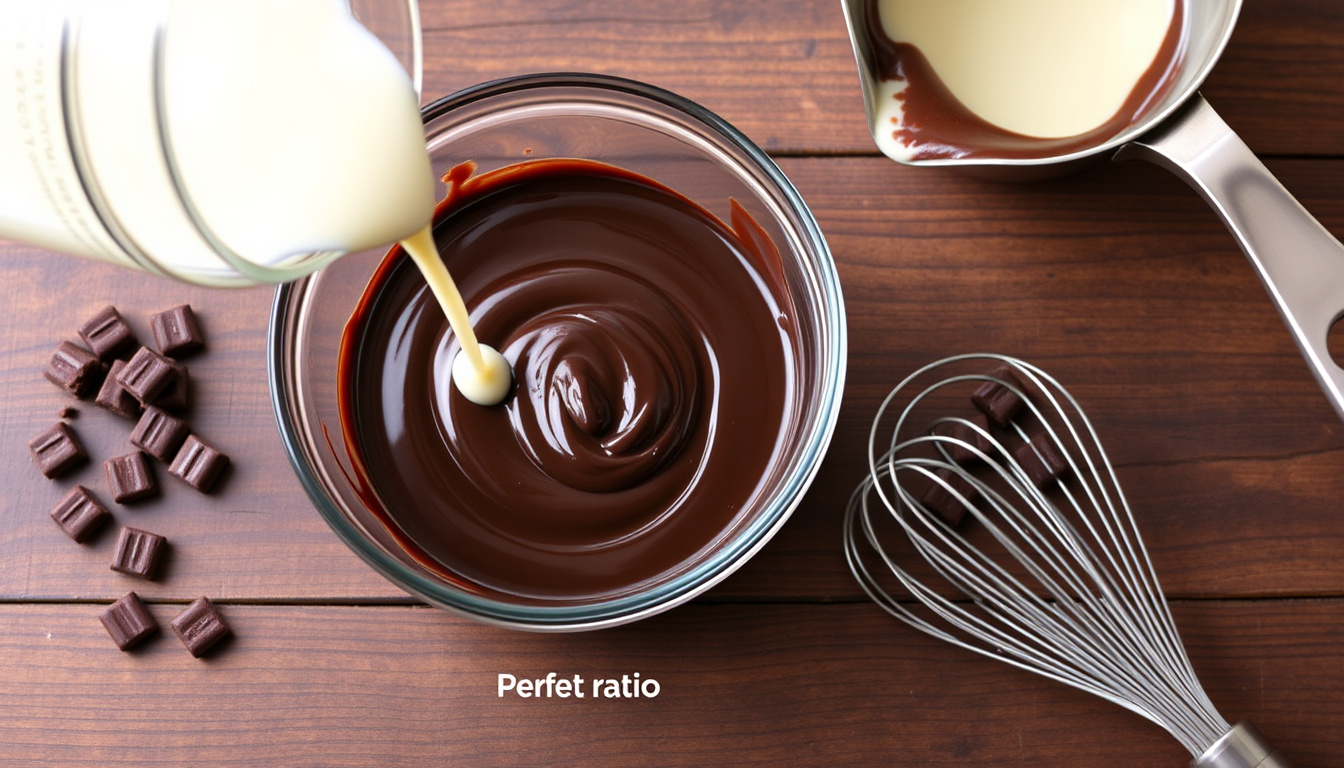
There’s a reason chocolate ganache feels like a secret weapon in the kitchen. With just two ingredients and a few minutes, you can create everything from a glossy cake drip to a rich truffle filling, but getting it right means knowing the ratio and avoiding common pitfalls.
Total time: 10 minutes ·
Ingredients: 2 (chocolate, cream) ·
Storage: Up to 2 weeks refrigerated ·
Yield: 1 cup (240 ml)
Quick snapshot
- Standard ratio for pouring ganache is 1:1 chocolate to cream by weight (Sally’s Baking).
- Heating cream to just below boiling is sufficient to melt the chocolate (Handle the Heat).
- Exact origin of the term “ganache” is debated; some sources attribute it to French patisserie in the 19th century. (Baker Bettie)
- Optimal cooling time for whipped ganache varies by ambient temperature and cream fat content (Baker Bettie).
- Preparation takes about 10 minutes; ganache sets in 1–2 hours at room temperature (Preppy Kitchen).
- Use immediately for drips, cool to spread, or whip for frosting (Sally’s Baking).
Four ratios, one pattern: the higher the chocolate-to-cream ratio, the firmer the final ganache. Each serves a specific use case.
| Label | Value |
|---|---|
| Total time | 10 minutes |
| Ingredients | 2 (chocolate, heavy cream) |
| Storage | Refrigerate up to 2 weeks |
| Yield | 1 cup (240 ml) from 4 oz chocolate + 4 oz cream |
| Chocolate type | Dark (60-70% cocoa) recommended for standard recipe |
How do you make a simple ganache?
Basic ingredients for simple ganache
- Chocolate: use dark chocolate with 60–70% cocoa solids for the best balance of sweetness and structure (Sally’s Baking (recipe blog)).
- Heavy cream: at least 36% milk fat ensures a stable emulsion (Handle the Heat (baking resource)).
Step-by-step instructions for simple ganache
- Chop the chocolate into small, uniform pieces so it melts evenly (Baker Bettie (culinary educator)).
- Heat the cream in a small saucepan over medium heat until it just simmers — small bubbles around the edge, not a full boil (Sally’s Baking (recipe blog)).
- Pour the hot cream over the chopped chocolate. Let it sit undisturbed for 3–5 minutes (Baker Bettie (culinary educator)).
- Stir gently with a silicone spatula, moving in one direction, until the mixture is smooth and glossy (Handle the Heat (baking resource)).
- Use immediately for a pourable glaze, or let it cool to room temperature for a spreadable consistency.
How to fix ganache that is too thin or too thick
Too thin? Add more finely chopped chocolate and stir over a double boiler until melted. Too thick? Warm a small amount of cream and stir it in, a teaspoon at a time (Sugar Spun Run (baking site)).
A thin ganache drips beautifully but won’t hold structure; a thick ganache holds shape but can be too stiff for pouring. Match the ratio to the job, not the other way around.
The implication: simple ganache is forgiving if you stay within the 1:1 to 2:1 range and control temperature. Most failures come from rushing the rest time or overheating the cream.
The implication: simple ganache is forgiving if you stay within the 1:1 to 2:1 range and control temperature. Most failures come from rushing the rest time or overheating the cream.
What is the best ratio for chocolate ganache?
Pouring ganache (1:1 ratio)
- Equal parts chocolate and cream by weight yields a thin, pourable glaze that sets with a slight sheen (Sally’s Baking (recipe blog)).
- Best for drip cakes, tart glazes, and ice cream toppings.
Glazing ganache (2:1 ratio)
- Two parts chocolate to one part cream by weight creates a firm but spreadable paste that covers cakes evenly (Handle the Heat (baking resource)).
- Ideal for filling between layers or coating an entire cake.
Truffle ganache (3:1 ratio)
- Three parts chocolate to one part cream by weight produces a very firm paste that can be rolled into truffles (Chef Lindsey Farr (professional pastry)).
- Chill completely before shaping.
Whipped ganache (starting 2:1 then whipped)
- Cool a 2:1 ganache to room temperature, then whip with a mixer until light and fluffy — like a chocolate mousse frosting (Beyond Frosting (dessert blog)).
- Great for piping and layered cakes.
A 1:1.5 ratio (more cream than chocolate) is sometimes used for very thin sauces, but the emulsion becomes fragile. Stick to the standard ratios for reliability.
The pattern: each ratio is a tool, not a rule. Pouring (1:1) gives flow; glazing (2:1) gives coverage; truffle (3:1) gives structure. Pick the ratio that matches your final use, not the one that sounds easiest.
The pattern: each ratio is a tool, not a rule. Pouring (1:1) gives flow; glazing (2:1) gives coverage; truffle (3:1) gives structure. Pick the ratio that matches your final use, not the one that sounds easiest.
How to make Mary Berry chocolate ganache?
Mary Berry’s specific ingredients and method
- Use dark chocolate (about 60% cocoa) and double cream (British heavy cream with 48% fat) (BBC Good Food (UK editorial recipe site)).
- Heat cream just below boiling, pour over chopped chocolate, stir until melted.
How her method differs from the standard approach
- Mary Berry adds a knob of butter (about 1 tbsp per 200g chocolate) for extra shine and a softer set (BBC Good Food (UK editorial recipe site)).
- She recommends using a wooden spoon rather than a whisk to avoid incorporating air.
Tips for following her recipe successfully
- If you can’t find double cream, substitute heavy cream with a splash of whole milk to raise the fat content.
- Let the ganache cool to a spreadable consistency before using on a cake, about 30 minutes at room temperature.
“A silky blend of dark chocolate, sugar and double cream.”
The catch: Mary Berry’s butter trick works best for dark chocolate ganache. For milk chocolate, the extra butter can make it greasy — skip it and rely on the cream alone.
The catch: Mary Berry’s butter trick works best for dark chocolate ganache. For milk chocolate, the extra butter can make it greasy — skip it and rely on the cream alone.
What are common ganache mistakes to avoid?
Using wrong type of chocolate
- Low-quality chocolate with too little cocoa butter (under 40%) can produce a greasy, broken ganache (Sugar Spun Run (baking site)).
- Chocolate chips often contain stabilizers that prevent smooth melting — use a bar instead.
Overheating the cream
- Boiling cream can cause the fat to separate, leading to a grainy texture. Keep it at a bare simmer (Handle the Heat (baking resource)).
- If the cream is too hot, it will scorch the chocolate and create a dull, thick paste.
Not letting the ganache cool properly for its intended use
- Pouring warm ganache on a cold cake gives you drips that run down the side rather than a clean drip effect (Baker Bettie (culinary educator)).
- For a stable layer, the ganache must be cooled to a thick, spreadable consistency — about 20–30 minutes.
Adding cold liquid to warm ganache
- Adding cold cream or butter to warm ganache shocks the emulsion and causes separation. Always temper by warming the liquid first.
“Chocolate ganache is a mixture of chocolate and warm cream. Stirred until smooth, silky, and shiny.”
— Sally’s Baking Addiction (dessert blog)
What this means: most ganache failures are avoidable with temperature awareness. Keep cream below a boil, chocolate finely chopped, and never rush the emulsion.
What this means: most ganache failures are avoidable with temperature awareness. Keep cream below a boil, chocolate finely chopped, and never rush the emulsion.
How to make a nice chocolate ganache? (with variations)
Milk chocolate ganache recipe
- Use a 2:1 ratio (chocolate to cream) because milk chocolate has more sugar and less cocoa solids, so it sets softer (Chef Lindsey Farr (professional pastry)).
- Heat cream to simmer, pour over chopped milk chocolate, stir gently — avoid overheating as milk chocolate scorches easily.
White chocolate ganache recipe
- Use a 1:1 ratio (white chocolate to cream) but let the cream cool slightly (to about 140°F / 60°C) before pouring to prevent the white chocolate from seizing (Handle the Heat (baking resource)).
- White chocolate is more delicate — stir slowly and don’t overmix.
Vegan ganache with coconut cream
- Replace heavy cream with full-fat coconut cream (solid part from a can). Use a 1:1 ratio with dark chocolate (Beyond Frosting (dessert blog)).
- Work gently: coconut cream has a lower fat content and is more prone to separation.
Flavored ganache (vanilla, espresso, liqueur)
- Add 1 tsp vanilla extract or 1 tbsp espresso powder to the cream before heating for a flavor boost.
- For liqueur (e.g., Grand Marnier, Baileys), stir in 1–2 tbsp after the emulsion is formed — do not heat the alcohol.
“Ready in about 10 minutes.”
The trade-off: milk and white chocolate require a higher fat ratio to stay firm, while vegan ganaches sacrifice some stability. Test your chocolate brand — cocoa percentages vary, and your first batch is your best calibrator.
The trade-off: milk and white chocolate require a higher fat ratio to stay firm, while vegan ganaches sacrifice some stability. Test your chocolate brand — cocoa percentages vary, and your first batch is your best calibrator.
Confirmed facts
- Standard ratio for pouring ganache is 1:1 chocolate to cream by weight (Sally’s Baking).
- Heating cream to just below boiling is sufficient to melt the chocolate (Handle the Heat).
What’s unclear
- Exact origin of the term “ganache” is debated; some sources attribute it to French patisserie in the 19th century.
- Optimal cooling time for whipped ganache varies by ambient temperature and cream fat content (Baker Bettie).
For a detailed breakdown of the ideal chocolate-to-cream proportions, refer to this chocolate ganache ratio guide that explains common mistakes and step-by-step instructions.
Frequently asked questions
Can I use milk instead of cream in ganache?
Milk has too little fat (about 3.5%) to form a stable emulsion with chocolate. The result is a thin, broken sauce rather than a glossy ganache. Stick to heavy cream or a dairy-free alternative like coconut cream.
What is the difference between ganache and chocolate sauce?
Ganache is an emulsion of chocolate and cream — it sets when cooled. Chocolate sauce is typically made with water, sugar, and cocoa powder, and it stays liquid at room temperature.
How do you thicken ganache that is too runny?
Add more finely chopped chocolate and warm the mixture gently over a double boiler until the extra chocolate melts. Alternatively, chill the ganache for 15–20 minutes and re-whip.
Can you make ganache with chocolate chips?
Yes, but chocolate chips often contain stabilizers that prevent them from melting as smoothly as bar chocolate. For best results, use high-quality chips or chop a chocolate bar yourself.
How long does ganache last at room temperature?
Sealed properly in an airtight container, ganache can sit at room temperature (60–70°F / 15–21°C) for up to 3 days. After that, refrigerate it. Reheat gently in a water bath.
Can you freeze chocolate ganache?
Yes. Let it cool completely, then freeze in an airtight container for up to 3 months. Thaw overnight in the fridge and reheat slowly over a water bath, stirring gently.
Why did my ganache separate and how to fix it?
Separation usually means the cream was too hot or the mixture was stirred too fast. To rescue, pour it into a blender and blend on low for 10–15 seconds, or add a tablespoon of warm cream and whisk gently.
Can I use cocoa powder instead of chocolate for ganache?
Cocoa powder lacks the cocoa butter needed for an emulsion. You can make a cocoa-based glaze with powdered sugar and butter, but it won’t be true ganache. The texture and shine depend on chocolate.
For the home baker who values precision over guesswork, the choice is clear: invest in a kitchen scale and good chocolate, and learn one ratio at a time. Start with a 2:1 glazing ganache — it’s the most forgiving — and branch out from there, or risk a runny drip and a frustrated evening.

Ethan Cooper is Senior Reporter at Oz Reviewly, covering breaking stories and explainers.