
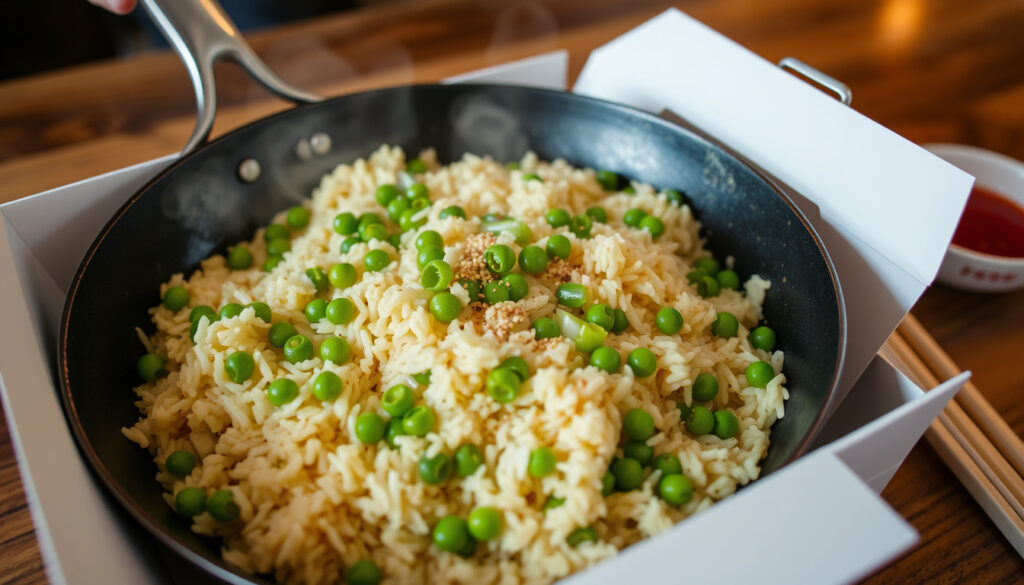
Anyone who’s tried making egg fried rice at home has faced the same puzzle: the takeaway version tastes impossibly good, while yours turns out heavy, clumpy, or just plain flat. The difference isn’t a secret ingredient — it’s a technique called velveting, and it changes how the egg behaves in the wok.
Total time: 10–15 minutes · Calories per serving: ~350 kcal · Key ingredients: 5 basic pantry items · Difficulty: Easy · Best rice to use: Day-old jasmine rice
Quick snapshot
- Day-old jasmine rice is ideal (The Woks of Life (Chinese cooking resource))
- Fresh rice can be dried on a tray (The Woks of Life (Chinese cooking resource))
- Avoid short-grain rice (too sticky) (The Woks of Life (Chinese cooking resource))
- Velvet egg: mix raw egg with cold rice before cooking
- Separate scramble: cook egg first, then combine (The Woks of Life, Chinese cooking resource)
- Direct crack works only with fast tossing
- MSG or mushroom powder for umami
- White pepper instead of black
- Sesame oil finish
- Soggy rice from fresh rice or too much sauce (The Woks of Life, Chinese cooking resource)
- Lack of wok hei from low heat
- Overcrowding the pan
Five key numbers, one pattern: the entire dish hinges on heat management and rice moisture.
| Metric | Value |
|---|---|
| Prep time | 5 minutes |
| Cook time | 10 minutes |
| Servings | 2–3 |
| Calories per serving | ~350 kcal |
| Key equipment | Wok or large non-stick skillet |
- Prepare the rice: Use day-old jasmine rice. If only fresh rice is available, spread it on a tray and refrigerate uncovered for an hour.
- Velvet the egg: Whisk eggs with a teaspoon of cornstarch and a splash of water to create the velvet coating before cooking.
- Preheat the wok: Heat until it smokes lightly, then add peanut oil with a high smoke point of 450°F.
- Stir-fry: Add the rice and egg mixture, tossing constantly over high heat for about 90 seconds.
- Season and serve: Drizzle soy sauce around the wok edge, add white pepper, and finish with sesame oil off the heat.
How do you make good egg fried rice?
Choosing the right rice
- Day-old refrigerated jasmine rice is the gold standard. Fresh rice carries excess moisture that turns stir-fry into mush (The Woks of Life, Chinese cooking resource).
- If you only have fresh rice, spread it on a baking sheet and refrigerate uncovered for an hour to dry the surface.
- Long-grain varieties (jasmine, basmati) yield separate grains; short-grain becomes sticky and clumps.
The implication: moisture control is not optional — it’s the foundation. Without dry, cold rice, every other technique falls apart.
Prepping ingredients
- Pre-cook proteins (chicken, shrimp, pork) and vegetables before they meet the rice. Stir-frying is too fast to cook raw ingredients through.
- Beat eggs in a bowl with a pinch of salt and a teaspoon of cornstarch slurry — this is the start of the velvet egg method (YouTube (Cantonese cooking tutorial)).
- Have everything within arm’s reach: once the wok is hot, there is no pause.
High-heat wok technique
- Heat your wok or skillet until it smokes lightly. Peanut oil (smoke point 450°F) handles the temperature without burning (The Woks of Life, Chinese cooking resource).
- Cook in small batches — overcrowding drops the pan temperature and steams the rice instead of frying it.
- Toss constantly. Grains should spend only about 90 seconds over high heat once the egg is in.
The pattern: high heat plus constant motion equals wok hei — that smoky, charred aroma that defines takeaway fried rice.
Velveting the egg
- Velveting is a classic Chinese technique that uses egg white and cornstarch to coat ingredients before cooking (TASTE (culinary education platform)).
- For egg fried rice, velvet the egg by whisking it with a teaspoon of cornstarch and a splash of water before adding to the rice. The starch raises the coagulation temperature, giving you a creamier, more even coating.
- Alternatively, scramble the egg separately in a little oil, remove it, then toss with the rice at the last minute. This gives you visible flecks of egg rather than a uniform coat.
Home cooks who velvet the egg get closer to takeaway texture than those who crack raw egg straight into the pan, because the starch buffer prevents sudden scrambling and clumping.
Can you just crack an egg into fried rice?
Why cracking directly can lead to clumps
- Raw egg dropped into hot rice coagulates almost instantly on contact. The result is uneven, rubbery blobs of egg surrounded by bare rice (The Woks of Life, Chinese cooking resource).
- The high water content in raw egg also introduces steam, making the rice surface wet and sticky.
The velvet egg method
- Mixing raw egg with cold rice before heating allows the egg to coat each grain evenly. When heat is applied, the egg sets as a thin, silky layer around every grain rather than forming isolated curds.
- The cornstarch in the slurry stabilises the protein structure, preventing the egg from weeping water (TASTE, culinary education platform).
When cracking directly works (with technique)
- Some experienced cooks crack an egg directly into the wok and toss ferociously for 20–30 seconds to distribute it before it sets (YouTube (Chinese cooking technique video)).
- This works only with very high heat, a light hand, and rice that is already dry and hot. For most home cooks, the velvet method delivers more reliable results.
Direct cracking is a pro move that fails more often than it succeeds in home kitchens because few home stoves sustain the heat needed to evaporate moisture fast enough to avoid clumps.
The pattern: the better your heat control, the more flexibility you have with egg technique — but velvet remains the most forgiving path for home cooks.
What are common mistakes when making egg fried rice?
Using fresh rice
- Freshly cooked rice has a moisture content above 60%, which releases steam in the wok and turns the dish into a porridge-like mess (The Woks of Life, Chinese cooking resource).
- Day-old rice has lost about 15% of that moisture through retrogradation, making the grains firm and separate.
Insufficient heat
- A wok below 375°F cannot produce wok hei. The rice absorbs oil instead of being seared, leaving a greasy, heavy texture.
- Electric stoves struggle to reach wok temperature. A portable butane burner or cast-iron skillet can compensate.
Overcrowding the wok
- More than about 2 cups of rice in a standard 14-inch wok drops the surface temperature below the searing threshold (The Woks of Life, Chinese cooking resource).
- Cook in batches if you’re making more than two servings. The extra 3 minutes per batch is worth it.
Adding too much sauce
- Soy sauce should be drizzled around the wok edge — about 1 teaspoon per serving — not poured directly onto the rice. Any more and the grains absorb liquid and soften (The Woks of Life, Chinese cooking resource).
- Dark soy sauce is thicker and sweeter; use half the amount you would with light soy sauce.
What this means: every common mistake traces back to one variable — moisture. Fresh rice, low heat, overcrowding, and excess sauce all add water that defeats the goal of separate, slightly chewy grains.
How to make egg fried rice taste like Chinese takeaway?
Key ingredients: MSG, white pepper, sesame oil
- Monosodium glutamate (MSG) or natural glutamate sources such as mushroom powder provide the savoury depth that distinguishes takeaway fried rice from home versions.
- White pepper delivers a clean, mild heat that black pepper cannot match. It’s a standard in Chinese restaurant kitchens.
- Sesame oil should be drizzled after the heat is off — about ½ teaspoon per serving — to preserve its aroma.
High heat and wok hei
- Wok hei — literally “wok breath” — is the smoky flavour imparted by oil hitting a very hot wok. It can be mimicked on a home stove by using a cast-iron skillet preheated for 5 minutes on maximum heat (The Woks of Life, Chinese cooking resource).
- A stainless steel pan also works; non-stick coatings limit the maximum safe temperature.
Using leftover rice
- Leftover rice that has spent 12–24 hours in the fridge undergoes retrogradation: starch crystals reorganise, making grains firmer and less sticky (The Woks of Life, Chinese cooking resource).
- This structural change is what allows the rice to survive high-heat tossing without turning into paste.
Seasoning balance
- Salt first, soy sauce second. Salt controls the baseline salinity; soy sauce adds colour and a fermented note.
- A pinch of sugar (about ⅛ teaspoon per serving) rounds out the savoury flavours without making the dish sweet.
The trade-off: authentic takeaway flavour requires either MSG or a natural glutamate alternative. Omitting it leaves the dish flat, but adding it requires a clear label for anyone with glutamate sensitivity.
What are the essential ingredients for egg fried rice?
Rice (day-old jasmine or long-grain)
- Jasmine rice is preferred for its floral fragrance and ability to stay separate after cooling (The Woks of Life, Chinese cooking resource).
- Basmati works but its stronger aroma competes with the egg and seasoning.
Eggs
- Fresh, large eggs. The yolk adds richness; the white provides structure.
- Using the velvet method (egg plus cornstarch slurry) changes the texture from rubbery to silky (TASTE, culinary education platform).
Oil (peanut or vegetable)
- Peanut oil has a smoke point of 450°F and a neutral flavour that doesn’t mask the egg.
- Vegetable oil blends are acceptable but avoid olive oil — its smoke point is too low and flavour too assertive.
Seasoning (soy sauce, white pepper, salt)
- Light soy sauce for salt and colour; white pepper for heat; sea salt for baseline seasoning.
- The total liquid from soy sauce should not exceed 1 tablespoon per 2 cups of cooked rice.
Optional flavour boosters (scallion, garlic, MSG)
- Scallion whites go in early with the oil; scallion greens are tossed in at the end for freshness.
- MSG (or mushroom powder) at about ¼ teaspoon per serving replicates the takeaway umami profile.
Why this matters: the ingredient list is short, so each component carries weight. Cheap soy sauce or old eggs will be exposed — there’s nowhere to hide.
What’s confirmed and what’s still unclear
Confirmed facts
- Day-old rice produces significantly better texture than fresh (The Woks of Life, Chinese cooking resource).
- High heat (above 375°F) is essential for wok hei and preventing oily rice (The Woks of Life, Chinese cooking resource).
- Scrambling egg separately gives more control over doneness and texture.
- Soy sauce should be added sparingly — no more than 1 tablespoon per two servings.
What’s unclear
- Whether adding egg directly to the rice or cooking it separately yields the “better” result — the answer depends entirely on your heat source and technique.
- Whether MSG is strictly necessary for takeaway taste: some high-rated recipes omit it and rely on mushroom powder or straight salt.
- The optimal oil smoke point versus health trade-off — peanut oil performs best but is less heart-healthy than avocado or grapeseed oil.
The takeaway: even the best recipes leave room for personal preference and equipment limitations, which is why testing and adjusting matters more than following rules blindly.
Perspectives from the kitchen
“Day-old rice is non-negotiable. If you use fresh rice, the grains are too soft and they’ll break apart as soon as you touch them with a wok spatula. The fridge dries them out just enough so they can take the heat.”
— Chef from Madewithlau (Chinese restaurant veteran) — The Woks of Life (Chinese cooking resource)
“The velvet technique isn’t just for meat. Applying the same principle to eggs — a little cornstarch, a little liquid — raises the temperature at which the protein sets, so you get a silky coating instead of a scramble.”
— Kenji López-Alt, Serious Eats / The Food Lab — TASTE (culinary education platform)
“You see people add soya sauce until the rice is brown. That is not egg fried rice. That is soya sauce rice with some egg in it. The egg should be the star.”
— Uncle Roger (food critic and humorist) — YouTube (Cantonese cooking tutorial)
The pattern across every perspective: respect the ingredients, control moisture, and let heat do the work. No shortcut replaces technique.
For the home cook in London or Los Angeles who wants takeaway-quality egg fried rice on a weeknight, the choice is clear: invest in day-old jasmine rice, a hot pan, and the velvet egg method, or accept a heavier, clumpier dish that tastes like compromise rather than craft.
Related reading: restaurant-style Chinese egg fried rice
For those who want to replicate that authentic takeaway taste, our perfect egg fried rice guide covers all the essential techniques.
Frequently asked questions
Can I use brown rice for egg fried rice?
Yes, but brown rice holds more moisture and has a chewier texture. Dry it thoroughly before stir-frying, and consider using slightly less liquid in the cooking process.
What is the best substitute for soy sauce?
Coconut aminos or tamari (gluten-free) work well. Fish sauce is a stronger alternative — use half the amount and expect a funkier flavour profile.
How do I prevent egg from sticking to the wok?
Preheat the wok until it smokes, add oil, swirl to coat, then pour out excess. This creates a non-stick seasoning layer. Non-stick skillets are a reliable alternative.
Can I make egg fried rice without a wok?
Yes. Use a large cast-iron or stainless steel skillet preheated on maximum heat. Avoid non-stick pans above medium-high — they can’t reach wok temperature safely.
Is egg fried rice gluten-free?
Standard soy sauce contains wheat. Use tamari or coconut aminos for a gluten-free version. All other core ingredients (rice, eggs, oil, white pepper) are naturally gluten-free.
How many carbs are in a serving of egg fried rice?
A typical 1.5-cup serving contains about 45–50 grams of carbohydrates, mostly from rice. The egg and oil add minimal carbs.
Can I add frozen vegetables directly to the rice?
Thaw and pat them dry first. Frozen vegetables release water into the wok, which drops the temperature and steams the rice. Dry vegetables keep the stir-fry crisp.
What wine or drink pairs well with egg fried rice?
A light lager or pilsner cuts through the richness. For wine, a dry Riesling or unoaked Chardonnay complements the egg and subtle soy notes.

Andrew Ellis leads fact-checking, source verification and corrections at Oz Reviewly.