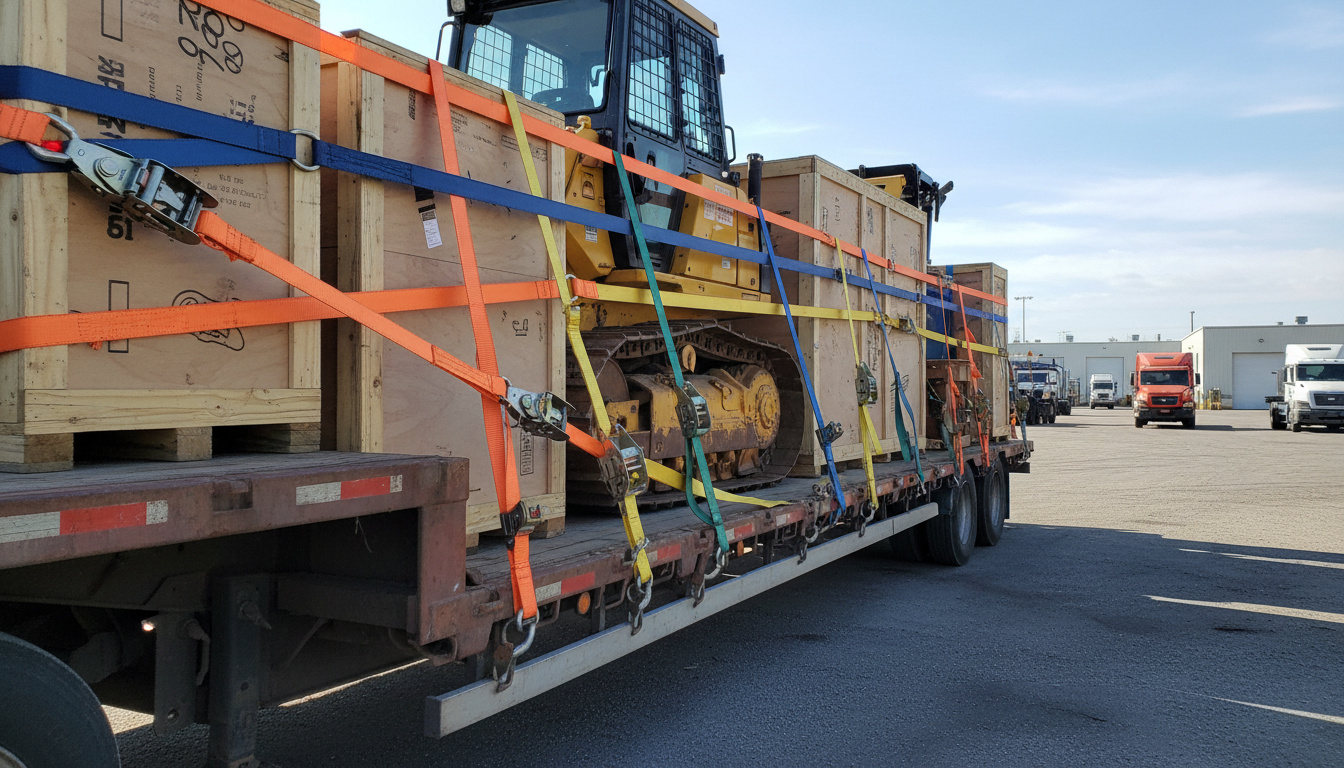

Tie down straps serve as the critical link between cargo and vehicle, preventing thousands of pounds of equipment from shifting during transport. These synthetic webbing assemblies, rated by Working Load Limit rather than breaking strength, create the friction and tension necessary to immobilize loads ranging from lightweight furniture to heavy construction equipment.
Understanding the distinction between ratchet mechanisms and cam buckles, alongside the federal requirements governing cargo securement, separates safe transport from liability exposure. Proper selection depends on matching strap specifications to load weight, transport distance, and environmental conditions.
What Are Tie Down Straps and Their Types?
Polyester (UV resistant) or Nylon (high stretch)
Ratchet straps and Cam buckle straps
500–5,670 lbs WLL depending on width
Trucks, motorcycles, flatbeds, towing
- Ratchet straps generate significantly higher tension than cam buckle mechanisms through lever-operated mechanical advantage.
- Working Load Limit equals one-third of breaking strength, providing a mandatory safety factor for dynamic forces.
- Polyester webbing resists UV degradation and abrasion better than nylon, making it standard for heavy-duty applications.
- Inspection for frays, cuts, and legible WLL tags must precede every use to maintain safety compliance.
- Two-inch straps represent the most versatile width, balancing strength and flexibility for trucks and motorcycles.
- Federal regulations require visible WLL markings on all tie-downs used in commercial transport.
- The aggregate Working Load Limit of all straps must equal at least 50 percent of the total cargo weight.
| Feature | Specifications |
|---|---|
| Working Load Limit (WLL) | One-third of break strength (e.g., 10,000 lb break = 3,333 lb WLL) |
| Standard Widths | 1-inch, 2-inch, 3-inch, 4-inch webbing |
| Material Properties | Polyester (low stretch, UV resistant), Nylon (high stretch, shock absorption) |
| Hook Types | S-hooks, J-hooks, flat hooks, wire hooks |
| Length Range | 6 feet to 30+ feet (12–16 ft most common for 2-inch straps) |
| Safety Factor | 3:1 ratio (break strength to WLL) |
| Regulatory Body | DOT/FMCSA cargo securement standards |
| Marking Requirement | WLL tag sewn into webbing, permanently visible |
How to Use Tie Down Straps Safely
Understanding Working Load Limits
The Working Load Limit (WLL) represents the maximum safe load a tie-down strap can handle during normal use, calculated as exactly one-third of its breaking strength. A strap rated at 15,000 pounds breaking strength carries a 5,000-pound WLL. DOT regulations mandate that WLL tags remain sewn into the webbing and fully legible, with fines reaching $10,000 or potential jail time for violations involving non-compliant or unmarked straps.
Breaking strength indicates the point at which the webbing or hardware fails under laboratory testing, but this figure ignores dynamic forces, shock loading, and wear patterns encountered during actual transport. Industry standards establish the 3:1 safety factor to account for these variables, ensuring straps maintain integrity even when cargo shifts during sudden braking or cornering.
Step-by-Step Securement Protocol
Proper securement begins with inspection. Check for cuts, abrasion, UV damage, or chemical contamination that could compromise webbing integrity. Verify that ratchet mechanisms function smoothly and that hooks show no deformation or cracks. Position straps at four or more securement points when possible, distributing tension evenly across the cargo.
For direct tie-downs where the strap attaches to both cargo and vehicle, only one-half of the strap’s WLL counts toward the aggregate securement capacity. Vehicle-to-vehicle ties apply full WLL values. Minimum requirements specify two tie-downs for loads under 10 feet, while cargo exceeding 10,000 pounds requires at least four straps. The combined WLL of all tie-downs must equal or exceed 50 percent of the total cargo weight.
Federal Motor Carrier Safety Administration rules require aggregate WLL at 50 percent or more of cargo weight. Using straps with insufficient ratings or missing WLL tags creates liability exposure up to $10,000 in fines.
Edge Protection and Tension Management
Sharp edges slice through polyester webbing under tension. Use edge protectors, corners, or sleeves whenever straps contact metal corners, pallet edges, or abrasive surfaces. Tension straps evenly without exceeding the stated WLL; over-tightening risks hardware failure or cargo damage while undertightening allows movement.
Choosing and Buying the Best Tie Down Straps
Selecting Width and Material
Webbing width directly correlates to strength capacity. One-inch straps handle 500–1,100 pounds WLL, suitable for pickup beds and light moving vans. Two-inch straps, the industry standard for trucks and motorcycles, provide 915–3,335 pounds WLL. Three-inch and four-inch varieties exceed 5,000 pounds WLL, reserved for flatbeds and heavy equipment.
Material selection depends on application. Polyester dominates heavy-duty use due to minimal stretch and superior UV resistance. Nylon stretches up to 20 percent under load, absorbing shock during dynamic securing scenarios like motorcycle transport, but degrades faster under sunlight exposure.
Mechanism Types: Ratchet Versus Cam Buckle
Ratchet straps employ a lever-operated mechanism that generates maximum tension through incremental tightening. These suit heavy loads and long-distance transport where vibration might loosen other systems. Cam buckle straps utilize a quick-release mechanism ideal for lighter loads requiring frequent adjustment, such as securing motorcycles or temporary holds during loading.
Coil straps loosely without kinks, storing them in dry locations away from direct sunlight and chemical exposure. Proper storage preserves WLL integrity and prevents premature webbing degradation.
Towing Applications
Tie-down straps function for towing when properly rated, following identical WLL calculations as standard cargo securement. Aggregate WLL must still meet or exceed 50 percent of the towed load’s weight. Use dedicated tow straps with appropriate end fittings rather than standard cargo straps for vehicle recovery operations.
When towing, calculate total WLL across all connection points. A 6,000-pound trailer requires minimum 3,000 pounds aggregate WLL distributed evenly between front and rear securement points.
Evolution of Cargo Securement Standards
- : Nylon webbing introduced for military and commercial cargo applications, replacing chains for light-duty transport.
- : Ratchet mechanisms standardized, allowing higher tension loads with mechanical advantage over cam buckles.
- : FMCSA publishes comprehensive cargo securement rules standardizing WLL calculations and marking requirements.
- : High-tenacity polyester becomes industry standard, offering superior UV resistance and reduced stretch compared to early nylon formulations.
- : Smart tags and RFID integration begin appearing on premium straps for digital WLL tracking and inspection logging.
Myth Versus Fact: What the Data Shows
| Common Misconception | Verified Reality |
|---|---|
| All straps of equal width carry identical strength ratings. | WLL varies significantly by material grade, stitching pattern, and hardware quality. Manufacturer markings provide the only reliable rating. |
| Breaking strength indicates safe working load. | WLL equals breaking strength divided by three. A 12,000-pound breaking strength translates to 4,000-pound safe working capacity. |
| Any strap works for any load if tightened sufficiently. | FMCSA mandates specific WLL minimums based on cargo weight. Exceeding WLL risks catastrophic failure regardless of tension. |
| Minor fraying does not affect overall strength. | Damaged webbing requires immediate retirement. Industry guidelines prohibit use of straps with cuts, burns, or abrasion. |
Regulatory Context and Industry Applications
The Federal Motor Carrier Safety Administration governs commercial cargo securement through performance criteria requiring tie-downs to prevent shifting forward, backward, sideways, and upward during transport. These rules apply to commercial vehicles exceeding 10,000 pounds gross vehicle weight rating, though best practices benefit all transport scenarios.
Commercial operators must maintain inspection records verifying WLL tag legibility, hardware integrity, and proper edge protection. For non-commercial users, similar diligence prevents roadside failures and cargo damage. Understanding these requirements proves essential whether securing equipment for a cross-country move or local equipment transport.
Applications span construction equipment transport, recreational vehicle securing, agricultural machinery movement, and general freight. Each context demands specific strap configurations, with motorcycle transport typically requiring four-point securement using 2-inch straps at 1,500+ pound WLL ratings.
Sources and Expert Authority
“Secure cargo to prevent shifting under all foreseeable driving conditions. The aggregate working load limit must be sufficient to restrain the cargo based on its weight and inertia.”
Federal Motor Carrier Safety Administration Cargo Securement Rules
“Always match strap WLL to load weight, remembering that the strap is only as strong as its weakest component—whether webbing, ratchet, or hook assembly.”
Industry Safety Standards, etrailer Technical Division
Key Takeaways for Secure Transport
Effective cargo securement requires understanding Working Load Limits as one-third of breaking strength, selecting appropriate width and material for specific loads, and maintaining strict inspection protocols. Whether transporting goods across town or planning a detailed itinerary including stops like the Watsons Bay Hotel, proper strap selection and usage prevent accidents, fines, and cargo loss. Verify WLL markings, distribute tension across multiple points, and replace damaged equipment immediately to maintain transport safety.
Frequently Asked Questions
How should tie down straps be stored to maintain integrity?
Coil straps loosely without kinks, storing them in dry environments away from direct sunlight, chemicals, and moisture. Proper storage prevents UV degradation and preserves the webbing’s rated WLL.
Can tie down straps be used for towing vehicles?
Yes, when properly rated. Towing applications require aggregate WLL at 50 percent or more of the towed weight, using straps with appropriate hooks and hardware designed for vehicle recovery rather than standard cargo securing.
What is the difference between breaking strength and Working Load Limit?
Breaking strength measures the point of failure during testing, while WLL equals one-third of that figure. A 9,000-pound breaking strength yields a 3,000-pound WLL, accounting for dynamic forces and safety margins.
How many straps are required for a standard load?
Federal guidelines require two tie-downs for cargo under 10 feet in length and 1,100 pounds. Loads exceeding 10,000 pounds require four or more straps, with aggregate WLL equaling at least 50 percent of total cargo weight.
Which material performs better: nylon or polyester?
Polyester resists UV damage and stretches less, making it ideal for heavy-duty trucking. Nylon absorbs shock better due to higher elasticity, suiting dynamic loads like motorcycles, but degrades faster under sunlight.
What happens if cargo exceeds the strap’s WLL?
Exceeding WLL risks webbing failure, hardware deformation, or complete strap separation. Dynamic forces during braking multiply static weight, meaning a 2,000-pound load can generate significantly higher effective forces.
How often should tie down straps be inspected?
Inspect before every use for cuts, abrasion, UV damage, and legible WLL tags. Retire straps immediately upon discovering damage, faded markings, or hardware defects regardless of apparent webbing condition.
Related stories





Liam O'Brien covers Australian politics and public affairs for Oz Reviewly.