
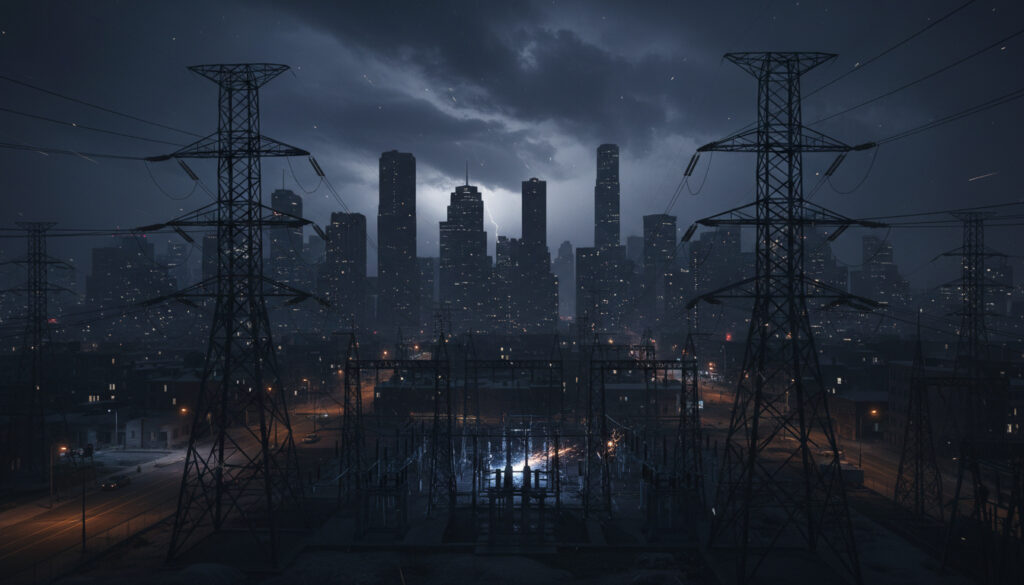
Lights Out: A Cyberattack, A Nation Unprepared, Surviving the Aftermath examines the vulnerability of the United States power grid to hostile cyber intrusions and electromagnetic pulse attacks. Published in 2016 by veteran journalist Ted Koppel, the investigative work argues that prolonged blackouts lasting weeks or months could sever access to electricity, clean water, food distribution networks, and emergency medical services.
The book constructs its case through interviews with security experts, power industry executives, and individuals who have taken extreme measures to prepare for societal collapse. Koppel contends that aging infrastructure and self-regulation within the utility sector create conditions where millions of citizens could face life-threatening shortages triggered by state-sponsored hackers or terrorist organizations.
Beyond technical analysis of transformer vulnerabilities and network architecture, the narrative explores the psychological and logistical challenges of modern dependence on electrical infrastructure. It profiles distinct communities—from individual preppers to organized religious groups—who have developed alternative survival systems in anticipation of catastrophic grid failure.
What Is the Book Lights Out About?
The work functions as both a warning and a journalistic investigation into the fragility of American infrastructure. Koppel opens with a hypothetical scenario depicting New York or Los Angeles plunging into total darkness, where electronic banking ceases, refrigeration fails, and municipal water systems stop functioning, leading to chaos and resource competition.
- Critical Infrastructure Risk: The U.S. power grid remains vulnerable to remote cyber intrusions and electromagnetic pulses capable of disabling vast geographical regions.
- Aging Hardware: Many transformers currently in operation exceed 40 years of age, require custom manufacturing, and can only be transported via specialized rail carriers, creating replacement bottlenecks.
- Regulatory Blind Spot: Koppel characterizes the power industry’s self-regulation as analogous to a “fox guarding the henhouse,” where profit motives conflict with security investments.
- Historical Precedents: The book cites the 2013 Metcalf Substation attack in California, where AK-47s were used against electrical equipment, and the 2003 Northeast blackout affecting 50 million people.
- Societal Dependencies: Modern urban survival depends on continuous electricity for water pumping, sewage treatment, food refrigeration, and financial transactions.
- Preparation Cultures: Communities in Virginia, Missouri, and Wyoming have developed stockpiling systems and off-grid capabilities independent of federal assistance.
- Government Limitations: Federal and state agencies lack comprehensive plans for managing blackouts extending beyond several days, particularly regarding transformer replacement logistics.
| Attribute | Details |
|---|---|
| Full Title | Lights Out: A Cyberattack, A Nation Unprepared, Surviving the Aftermath |
| Author | Ted Koppel |
| Publisher | Broadway Books (Penguin Random House) |
| Publication Date | |
| Pages | 288 |
| ISBN | 978-0553419962 |
| Retail Price | $16.00 USD |
| Format | Paperback/Hardcover |
| Category | Current Affairs/Infrastructure |
| Recognition | New York Times Bestseller |
Who Wrote Lights Out and When Was It Published?
Ted Koppel’s Investigative Background
Ted Koppel built his reputation through decades of broadcast journalism, most notably anchoring ABC’s Nightline program. For this book, he conducted extensive interviews with cybersecurity specialists, electrical utility executives, and survivalist communities to assess technical vulnerabilities often obscured by industry confidentiality. His methodology combines document analysis with field reporting across multiple states.
Koppel’s access to high-level security experts and industry insiders provides the book with primary source material rarely available to civilian researchers. The author’s investigative background enabled him to translate technical grid architecture concepts into accessible prose, though some technical sections retain specialized jargon.
Publication Specifications
Broadway Books, an imprint of Penguin Random House, released the 288-page volume on October 18, 2016. The work emerged during a period of increasing awareness regarding cyberwarfare capabilities, particularly following documented Russian intrusions into energy sector networks. Publisher records indicate the book achieved New York Times bestseller status shortly after release.
Is Lights Out Based on a True Story?
Documented Infrastructure Attacks
The book grounds its warnings in verifiable incidents rather than pure speculation. Koppel details the April 2013 Metcalf Substation attack near San Jose, California, where unidentified gunmen used AK-47 rifles to damage electrical transformers, demonstrating physical vulnerability despite causing no immediate blackout. He also examines the August 2003 Northeast blackout that affected approximately 50 million people across eight states and Canada.
Hypothetical Scenarios
While opening chapters describe fictionalized scenarios of New York or Los Angeles descending into darkness, these narratives serve as illustrative frameworks based on documented system vulnerabilities. Analysts note that Koppel distinguishes between confirmed historical events and speculative projections of coordinated cyber campaigns.
Expert Sourcing
The work cites interviews with former government officials, utility engineers, and military strategists regarding electromagnetic pulse capabilities and malware potential. Presentation materials from Koppel’s investigative process indicate reliance on classified and unclassified government assessments of grid fragility.
What Are the Main Themes and Key Takeaways?
Cyberwarfare Reality
Koppel establishes that state-sponsored cyber intrusions represent active threats rather than theoretical possibilities. The text references documented Russian hacking attempts against energy infrastructure as evidence that hostile actors possess both capability and intent to disrupt electrical distribution through remote access.
Replacement transformers for high-voltage grids require specialized manufacturing facilities overseas and transport via heavy rail systems that would be non-functional during widespread blackouts. Lead times for critical components extend to months or years, creating impossible recovery timelines for extended outages affecting multiple regions simultaneously.
Community Resilience Models
The book examines three distinct preparation models: individual preppers in Wyoming and Missouri maintaining bunkers and year-long food supplies; Mormon communities implementing organized, church-based mutual aid systems; and rural off-grid households utilizing solar and wind independence. Reviewers highlight Koppel’s finding that urban populations remain uniquely vulnerable due to dependence on complex supply chains.
Koppel draws sharp contrasts between isolated individual survivalism and organized community preparation. Mormon congregations maintain centralized food storage and communication protocols, offering more sustainable models for prolonged emergencies than solitary bunker approaches.
Regulatory Failure
Utility industry self-regulation emerges as a central obstacle to security upgrades. Koppel documents how industry lobbying has resisted federal mandates for physical security standards and cyber protection, leaving gaping vulnerabilities at substations and control centers.
Timeline of Real-World Grid Threats and Events
- : The Northeast Blackout affects 50 million people across eight U.S. states and Ontario, Canada, exposing the cascading failure potential of interconnected grids.
- : The Metcalf Substation attack in California involves sniper fire on electrical transformers, causing $15 million in damage and prompting federal security reviews.
- : Russian government-linked hackers conduct reconnaissance on U.S. energy sector networks, demonstrating persistent interest in critical infrastructure.
- : Broadway Books publishes Lights Out, synthesizing these events into a comprehensive vulnerability assessment.
- : Continued documented cyber intrusions from state actors validate Koppel’s warnings about ongoing grid targeting.
What Is Fact and What Remains Uncertain?
| Established Information | Unresolved Questions |
|---|---|
| The 2003 Northeast blackout and 2013 Metcalf attack occurred as described | Specific timelines for future coordinated cyber attacks remain unknown |
| High-voltage transformers require 12-18 months for replacement manufacture | Exact duration of societal disruption during multi-month blackouts is speculative |
| Russian and Chinese hackers have infiltrated energy sector networks | Government response capabilities during catastrophic grid failure remain untested |
| Self-regulation persists in utility security standards | Effectiveness of individual preparation strategies during actual collapse scenarios is theoretical |
| Mormon communities maintain organized food storage programs | Percentage of population that could survive 6+ months without grid power is undetermined |
Why Does Grid Vulnerability Matter Today?
Nearly a decade after publication, the infrastructure vulnerabilities Koppel identified persist without comprehensive federal remediation. Analysts note that transformer replacement times have not decreased, and cyber intrusion attempts against electrical utilities have increased in frequency and sophistication. The proliferation of ransomware attacks against critical infrastructure since 2020 validates concerns about network security gaps.
Climate change has introduced additional strain on aging grids, with extreme weather events causing regional outages that demonstrate the system’s fragility. The book’s central argument—that modern urban survival depends entirely on electrical continuity—has only intensified as populations grow and supply chains become more complex. Communities considering Tie Down Straps – Types, Uses, Safety and Best Picks for emergency logistics may find parallels in the transportation challenges Koppel describes for moving heavy electrical equipment during crises.
Interconnection previously seen as efficiency has become liability; smart grid technology intended to improve distribution has expanded the attack surface available to hostile actors. The tension between regulatory requirements and industry resistance to expensive security upgrades continues to define the policy landscape around electrical infrastructure protection.
What Do Experts Say About the Book?
“An excellent introduction to the realities of cyberwarfare and the specific vulnerabilities of the American electrical grid. Koppel succeeds in alerting citizens to the need for personal preparation while avoiding sensationalism.”
— SquareTwo Review
“The book effectively highlights urban dependence on electrical infrastructure and provides sobering analysis of prepper culture without ridicule. Koppel treats survivalists as rational responders to genuine systemic risks.”
— Saccade Analysis
“A sobering yet ultimately hopeful call to action that raises vital questions about national security. Essential reading for those interested in infrastructure resilience.”
— Recoil Offgrid
Is Lights Out Worth Reading?
The book serves as a foundational text for understanding critical infrastructure vulnerability, combining journalistic rigor with technical accessibility. Readers seeking guidance on Justice of Peace Near Me – Guides, Directories, Costs and Hours for emergency documentation needs may appreciate Koppel’s broader emphasis on bureaucratic continuity during disasters. While certain technical sections require focused attention, the work remains relevant for citizens, policymakers, and emergency managers evaluating national preparedness gaps. Its value lies not in providing comfort, but in documenting uncomfortable realities about the electrical foundation of modern American life.
Frequently Asked Questions
Is Lights Out a novel or work of non-fiction?
The book is strictly non-fiction investigative journalism. While it opens with hypothetical scenarios to illustrate risks, the core content consists of documented events, expert interviews, and verified infrastructure vulnerabilities.
What specific cyber threats does the book describe?
Koppel examines state-sponsored remote intrusions into SCADA systems, electromagnetic pulse attacks from atmospheric nuclear detonations, and coordinated physical assaults on transformer substations.
How long does Koppel suggest blackouts could last?
The book indicates that replacing damaged high-voltage transformers could require 12 to 18 months under current manufacturing and logistics constraints, potentially leaving regions without power for weeks or months.
Does the book recommend specific survival preparations?
Koppel profiles existing preparation communities but stops short of providing step-by-step survival guides. He emphasizes water storage, food independence, and community networking over isolated bunker mentalities.
Is the EMP threat scientifically credible according to the text?
The book cites military and scientific sources confirming that electromagnetic pulses could disable unprotected electrical infrastructure across wide geographic areas, though the probability of such events remains debated.
What government agencies does the book critique?
Koppel identifies gaps in coordination between the Department of Homeland Security, Federal Emergency Management Agency, and private utility operators, noting the absence of comprehensive plans for extended national blackouts.
Has the power grid improved since the book’s publication?
While individual utilities have enhanced cybersecurity, systemic vulnerabilities including transformer replacement bottlenecks and self-regulation standards persist largely unchanged since 2016.
Where can readers purchase the book?
The book remains available through major retailers including the publisher, Penguin Random House, and independent booksellers such as Powell’s Books.

Andrew Ellis leads fact-checking, source verification and corrections at Oz Reviewly.